Frequently Asked Questions

TMS delivers magnetic pulses to specific areas of the brain that regulate mood and emotional control. These pulses stimulate brain cells (neurons), creating changes in brain activity.
The frequency of the pulses determines whether brain activity in those regions increases or decreases. Over time, TMS can help restore balanced brain communication patterns, producing long-lasting improvement in mood and mental function.

Every patient is unique, but most clinical studies use one of the following treatment schedules:

  • Figure-8 Coil Treatment: Each session typically last 19 minutes or Thetaburst session done in 3.5 minutes
  • Accelerated TMS treatments can be given in 5 days or even one day, but insurance plan to not cover the 5 days treatment.
There is no known toxicity or harm from receiving additional sessions. In some cases, ongoing maintenance TMS is recommended to help maintain results.
Our practice accepts most major insurance plans and most smaller plans as well.
If you are interested in Transcranial Magnetic Stimulation (TMS) or Spravato Esketamine therapy, and we do not participate with your insurance plan, our office staff will assist you with the necessary paperwork to get an individual contract for out of network benefits for these treatments.

Accepted Insurance Plans

  • Aetna
  • Cigna
  • United Healthcare
  • Oxford Liberty
  • Blue Cross Blue Shield (PPO and EPO)
  • Medicare
  • 1199
  • Beacon Health Value Options
  • UHC Optum/Oscar
If you do not see your insurance listed above, please call the office to speak with one of our staff members about your individual coverage. In case we are not in-network with your insurance plan, we do have self-pay options available.
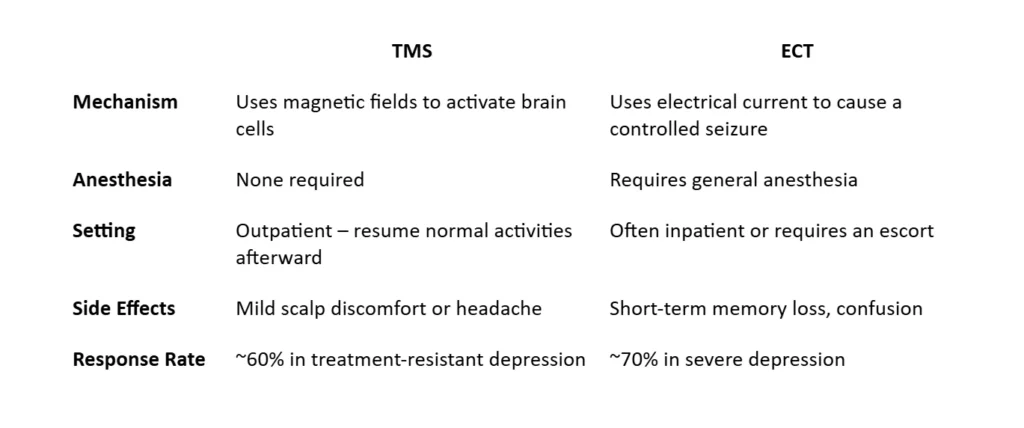
Both TMS and ECT (Electro-Convulsive Therapy) are brain stimulation treatments for depression, but they work very differently.
FAQ TMS
ECT remains the best option for certain severe or psychotic depressions, while TMS offers an effective, non-invasive alternative with minimal side effects.
Antidepressants work chemically, altering neurotransmitters in the brain. TMS works physically, using magnetic energy to improve brain connectivity and promote new cell growth.

Key differences:

  • No chemicals or systemic side effects (no impact on digestion, libido, or sleep).
  • No allergic reactions or drug interactions.
  • Faster onset: results often appear sooner than antidepressants.
  • Higher response rate: in patients who failed 2–3 medications, TMS success rate is ~60%, versus 10–15% for another antidepressant trial.
The most common side effect (>5%) is mild, temporary scalp discomfort or headache, which typically resolves after the first week.
Treatment sessions vary from 3 to 37 minutes for ThetaBurst Rx and up to 19 minutes for 10 Hz protocols.
TMS has been studied for multiple mental health and neurological conditions, including:
  • Depression (FDA-approved)
  • Obsessive-Compulsive Disorder (OCD) (FDA-approved)
  • Migraine (FDA-approved)
  • PTSD
  • Anxiety Disorders
  • Addiction
  • Fibromyalgia
  • Post-Stroke Recovery
  • Chronic Pain
TMS is best established for Major Depressive Disorder, and growing research supports its use for other conditions. Always consult your psychiatrist to confirm whether TMS is right for you.
Most patients experience only mild, short-term side effects, such as:
  • Scalp discomfort or tingling at the treatment site
  • Mild headache
  • Jaw, teeth, or eye discomfort (rare, temporary)
  • Slight anxiety or sleep changes in the first week
Serious side effects are extremely rare. The risk of a seizure is 1 in 60,000 sessions, lower than that of most antidepressant medications. Earplugs are used during sessions to protect hearing.
TMS has consistently shown strong results in both research and real-world practice:
  • ≈70% of patients experience at least a 50% improvement in symptoms.
  • ≈40% achieve full remission of depression.
  • For OCD, studies show 40% remission and 60% response rates.
TMS can also be effective even after ECT or multiple medication failures.
After completing TMS, you’ll continue follow-up visits with your clinician to monitor progress and prevent relapse.
  • Many patients maintain improvement for a year or longer without additional treatment.
  • Some may benefit from booster or maintenance sessions (e.g., it varies from patient’s particular history).
  • Your provider may recommend combining TMS with therapy or medication for ongoing stability.
If TMS does not produce the desired results, your psychiatrist will review other options such as:
  • Adjusting TMS protocol or coil placement
  • Medication changes or augmentation
  • Psychotherapy
  • ECT (in certain cases)
Roughly 40% of patients who don’t respond initially may still improve with adjusted protocols or combination approaches.

While response time varies, most patients begin noticing improvement after 2–3 weeks of consistent sessions (5 days per week).

Some notice changes sooner, while others respond closer to week 4–5. Early signs include better sleep, energy, and focus — followed by improved mood.

At Sleep, TMS & Wellness Psychiatry, patients receive ongoing coaching on essential wellness factors throughout their TMS treatment. This guidance focuses on improving sleep–wake cycles, establishing daily exercise routines, supporting healthy nutrition and hydration, reducing stress through a positive mindset, and strengthening social connectedness.

As mood and motivation begin to improve—often within the first few weeks of TMS—patients are encouraged to set meaningful short-term goals for the next 3–6 months. Using principles of Behavioral Activation Therapy, our team helps patients re-engage in daily routines and activities that promote positive feelings, emotional resilience, and steady progress toward personal and work-related goals.
To support patients and providers in understanding the science behind TMS and modern psychiatric care, we’ve compiled a list of reputable, evidence-based organizations and clinical resources. These links offer education, treatment guidelines, research updates, and patient support tools:
  • Apollo TMS – Clinical information and device details for Apollo TMS technology.
  • Clinical TMS Society – A leading organization dedicated to advancing TMS education, safety, and clinical excellence.
  • American Psychiatric Association (APA) – The premier authority on psychiatric standards, mental health research, and treatment guidelines.
  • Psychosomatic Medicine Society – Resources on the connection between mental and physical health, including integrative treatment approaches.
  • Spravato® (Esketamine) Website – FDA-approved treatment information for treatment-resistant depression.
  • American Neuropsychiatric Association (ANPA) – Professional organization focused on the intersection of neurology and psychiatry.
These trusted sources help patients stay informed and empower clinicians to deliver the highest standard of care.

As part of your comprehensive psychiatric evaluation, Dr. Gupta may recommend specific medical tests to better understand the biological factors contributing to your symptoms. These assessments help guide personalized treatment decisions and ensure the safest, most effective care plan. Depending on your needs, the workup may include:

  • Genomind Genetic Testing: Evaluates genetic markers that may influence how you respond to certain medications, helping identify what to adjust, taper, or optimize—especially in treatment-resistant depression.
  • Laboratory Work: Tests may check for thyroid dysfunction, vitamin B12 or D deficiencies, inflammation markers such as CRP and ferritin, and general health indicators like CBC, liver and kidney function tests.
  • CNS Cognitive Testing: Computerized testing designed to assess cognitive function and rule out impairments in memory, attention, or processing speed.
  • Sleep Evaluation: May include home sleep testing to screen for sleep apnea and insomnia, or an in-lab polysomnogram (PSG) when a more detailed assessment is required.
  • Brain EEG (QEEG): Performed in select cases to analyze brainwave patterns before and after TMS. These findings help tailor treatment parameters and enhance TMS effectiveness.
This thorough medical assessment ensures a precision-based, personalized approach to your mental wellness journey.
These trusted sources help patients stay informed and empower clinicians to deliver the highest standard of care.