Key message: Accelerated TMS may offer faster treatment in a shorter time frame, but it is not a replacement for standard TMS. Standard TMS remains the most established, commonly used, and often insurance-covered choice for many patients.
What Is the Difference?
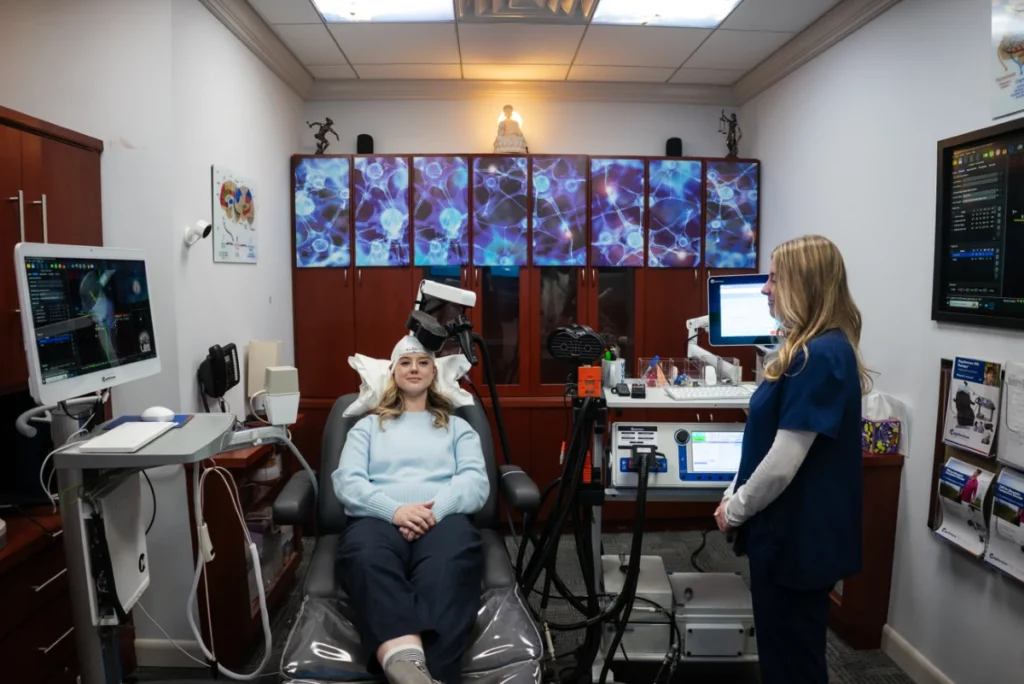
Standard TMS is usually delivered once each weekday for about six to seven weeks. It has a strong evidence base, extensive clinical experience, and established insurance pathways for eligible patients with major depressive disorder.
Accelerated TMS delivers several sessions per day, separated by rest intervals, allowing treatment to be completed over several days or a shorter series. Protocols vary in dose, number of sessions, targeting method, and treatment duration; not every accelerated program is the same as the Stanford SAINT protocol.
How Theta-Burst Stimulation Supports Neuroplasticity
Theta-burst stimulation delivers magnetic pulses in a pattern inspired by the brain’s naturally occurring theta and gamma rhythms—rhythms involved in communication, learning, and neuroplasticity. This biologically informed pattern can promote lasting changes in mood-related brain networks within a much shorter treatment session.
Standard TMS
Accelerated TMS
One weekday session for ~6–7 weeks
Multiple daily sessions over a shorter course
Patients who can attend regularly and want to use insurance
Patients needing faster care or unable to sustain weeks of visits
Often covered when plan criteria are met
Frequently self-pay; verify the exact plan and protocol
Standard TMS:
One weekday session for ~6–7 weeks
Accelerated TMS:
Multiple daily sessions over a shorter course
Best fit
Standard TMS:
Patients who can attend regularly and want to use insurance
Accelerated TMS:
Patients needing faster care or unable to sustain weeks of visits
Coverage
Standard TMS:
Often covered when plan criteria are met
Accelerated TMS:
Frequently self-pay; verify the exact plan and protocol
What Did the Stanford SAINT Trial Show?
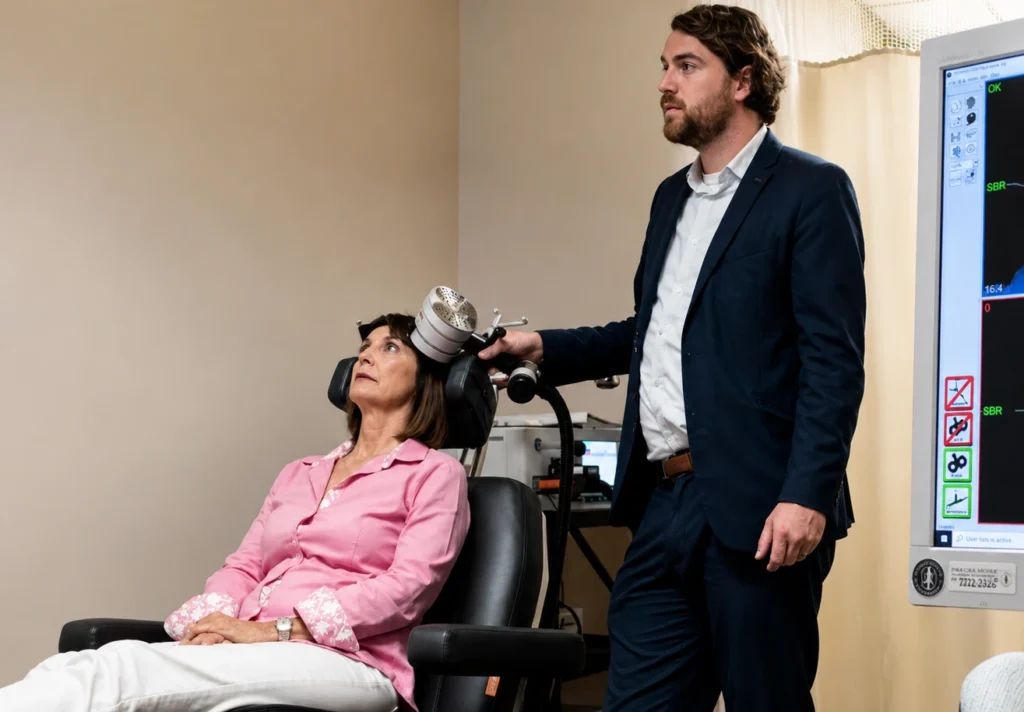
The randomized, double-blind Stanford study used an intensive, individualized protocol: functional-connectivity MRI targeting, intermittent theta-burst stimulation, 10 sessions per day, and five treatment days. At the prespecified assessment, 79% of the active-treatment group achieved remission versus 13% with sham. The study was important but small—29 participants completed treatment—and its results should not be treated as a guarantee or directly compared with a single standard-TMS remission figure.
What Makes SAINT Different?
Both SAINT and other accelerated TMS programs may deliver several theta-burst sessions daily over five days. SAINT adds individualized functional-MRI mapping to identify a depression-network target unique to each patient and follows a specific high-dose, FDA-cleared treatment system. Accelerated TMS without fMRI uses a standardized or anatomically determined target, making it simpler and potentially more accessible, but it should not be presented as equivalent to SAINT or expected to produce identical results.
Accelerated TMS research began before SAINT, but the Stanford studies created a major paradigm shift by demonstrating that a full, intensive course of precisely targeted iTBS could be delivered over five days with rapid antidepressant effects. This work helped catalyze broader interest in accelerated schedules and encouraged development of more practical approaches to faster depression treatment.
Availability and Insurance
SAINT is not yet in widespread routine use. Its individualized fMRI mapping, proprietary targeting, specialized equipment, and intensive schedule can make treatment costly and available mainly at selected centers. Insurance coverage remains limited; many plans do not routinely reimburse the fMRI mapping or full treatment course, so coverage and out-of-pocket costs should be verified in advance.
Who May Benefit Most From Considering Accelerated TMS?
- Patients whose clinical condition creates a reasonable need to pursue improvement more quickly.
- Patients whose health, travel distance, caregiving duties, or disability makes six to seven weeks of weekday visits difficult.
- Busy professionals, executives, business owners, or students who cannot leave work or school every weekday.
- Selected patients with a prior partial response, relapse, or inadequate response after TMS, following individualized reassessment.
These are reasons for a clinical discussion—not automatic indications. Diagnosis, severity, medication history, seizure risk, implanted devices, prior response, cost, and patient preference must all be considered.
Why Standard TMS Remains an Excellent Choice
Standard TMS is not an outdated or lesser treatment. It remains the most widely used pathway and may be the better choice when a patient can attend weekday sessions, prefers a gradual schedule, or wants to use insurance benefits. Many patients respond well to standard TMS, and it should continue to be presented as the appropriate first option for many people.
FDA Clearance and Insurance: Important Clarifications
TMS devices receive FDA clearance rather than medication-style FDA approval. The Magnus Neuromodulation System with SAINT Technology is FDA-cleared for adults with major depressive disorder who have not achieved satisfactory improvement from antidepressant medication in the current episode. This clearance applies to the specific Magnus SAINT system; it does not mean that every accelerated or five-day TMS protocol is FDA-cleared.
In 2026, standard TMS is commonly reimbursed for eligible depression treatment after prior authorization. Accelerated TMS is still frequently not reimbursed and is often self-pay. Some insurers may reconsider policies as evidence and coding pathways develop during 2026–2027, but there is no guaranteed coverage timetable. Benefits and financial responsibility should be verified in writing before treatment.
The Bottom Line
Accelerated TMS adds an important option—particularly when faster treatment or fewer travel days matter. Standard TMS nevertheless remains the established, accessible, and often insurance-covered choice for many patients. At Sleep, TMS & Wellness Psychiatry (STW) , the goal is not to recommend the newest or fastest schedule to everyone, but to select the safest, most evidence-informed, practical, and financially transparent treatment for everyone. At STW the use of brain wave study ( qEEG) and brain blow flow (fNIRS) and MRI guided neuro-navigation is standard process offered to all patients weather standard TMS or accelerated TMS. Our goal is to offer the personalized neuromodulation treatment for maximal therapeutic outcomes.
Schedule a consultation: To discuss standard or accelerated TMS, call Sleep, TMS & Wellness Psychiatry at (516) 684-9535 or visit dragupta.com.
Sources
- Larson J, Wong D, Lynch G. Patterned stimulation at the theta frequency is optimal for the induction of hippocampal long-term potentiation. Brain Research (1986).
- Huang YZ, Edwards MJ, Rounis E, Bhatia KP, Rothwell JC. Theta burst stimulation of the human motor cortex. Neuron (2005).
- Huang YZ et al. The after-effect of human theta burst stimulation is NMDA receptor dependent. Clinical Neurophysiology (2007).
- Blumberger DM et al. Effectiveness of theta burst versus high-frequency repetitive transcranial magnetic stimulation in patients with depression: the THREE-D randomized non-inferiority trial. The Lancet (2018).
- Cole EJ et al. Stanford Neuromodulation Therapy (SNT): a double-blind randomized controlled trial. American Journal of Psychiatry (2022).
- U.S. Food and Drug Administration. 510(k) Premarket Notification database: Magnus Neuromodulation System with SAINT Technology (K220177).
Medical disclaimer: This article is for educational purposes and does not constitute medical advice. Individual outcomes vary. A qualified clinician must determine whether TMS and a particular protocol are appropriate.